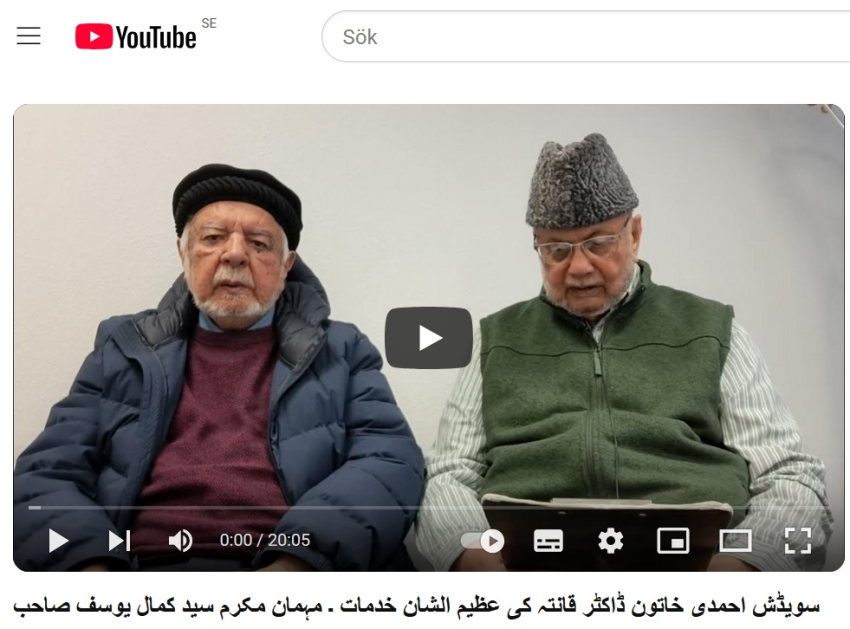
In 2024 Khawaja Abdul Momin Sb. interviews Kamal Yousuf sb., Norway,
about Dr. Qanita. episode 3
 Kamal Yousuf sb speaking:
Dr. Qanita was the national Lajnah president in Denmark before moving to Germany. Then she was the very first national Lajnah president in Frankfurt, and this was during the time of Amir Fazal Ilahi Anweri Sb. She was also the first national president for all of Germany. Fazal Ilaahi sb’s son, Zackariah, also visited at that time. He has since passed away, but his children are in Oslo, Norway. She was also the first national president of Lajnah in Sweden. During her presidency in both of these countries, she would send reports of her efforts, and she received certificates of appreciation from the international Lajna president, respected Umme Mateen sahiba. I have seen some of the letters she wrote to Dr. Qanita, in which she expressed her pleasure over Dr. Qanita’s performance.
At one time, Dr. Qanita’s house was located in a village near Svenljunga Sweden, and it was like a farmhouse. She renovated theat farmhouse. To my knowledge, she was the first person in countries like Europe, America, and Canada to establish a Baitul Du’a in her own home.
She specifically dedicated a room for Namaz and prayers when she resided in that house. During that time, the president of International Lajna, respected Umme Mateen sb (also known as hadhrat Choti Apa), visited Sweden. She expressed a desire to visit Dr. Qanita’s house. Upon visiting, she was very happy and remarked that the house, being located outside the main population, reminded her of the time when Hadhrat Musleh Maood had built houses near the river Bias, distant from Qadian. This was a reflection of the affection of Sayyeda Umme Mateen sahiba, who took the time to visit Dr. Qanita’s house.
When Dr. Qanita first attended Jalsa in Rabwah, Hadhrat Khalifatul Masih Salis lovingly gifted her a pair of gold bangles. She received many blessed gifts, and this was one of them. She had a close friendship with the wife of Sayyed Masood sb, Amir of Scandinavia, Amatul Rauf sahiba, and her sister Sayyeda Amatul Qaddus sahiba. She visited Rabwah many times and used to stay in the house of Apa Nasira Begum sahiba, wife of Hadhrat Mirza A. Mansoor Ahmad sb. She treated Dr. Qanita like a daughter. Dr. Qanita often says that she is Apa Nasra Begum sahiba’s adopted daughter and also received many blessed gifts from her.
Khawaja Abdul Momin sb: The mother of our present Hudhur?
Kamal Yousuf sb: Yes, Apa Nasira Begum sahiba was the mother of our present Hudhur.
Currently, Dr. Qanita is in contact with Mir Sayyed Mahmud Ahmad sb, who is the Secretary of Health ( Nazir sehat), and she receives the news from him about the family of the Promised Messiah (a.s.). She has visited Rabwah many times, despite the fact that she was often alone, and now she faces difficulty walking. She uses crutches to walk. She has also visited Qadian many times.
In Qadian, at the Bahishti Maqbara, on the outside of the boundary wall surrounding the grave site of the Promised Messiah (a.s.), there used to be a blackboard with the names of those who contributed money to build the wall. The first name, which slips my mind, donated Rs. 1700. He was handicapped and a Dervish. At that time, no Ahmadi in all of India had such a large amount of money. A flood was approaching, and there were no walls around the Bahishti Maqbara, which would have posed a major challenge. Among the donators, I have seen Dr. Qanita’s name as well.
Dr. Qanita could not tolerate the cold, so Hadhrat Khalifatul Masih Rabi suggested that she reside in a village in Ghana during the winter months. Imam Abdul Wahab Adam sb, who was the Amir of the Jama’at in Ghana (and who had the honor of being the only non-Indian and non-Pakistani Amir of Jama’at Rabwah during the time of Hadhrat Khalifatul Masih Salis), assisted her in opening a school in a small village and planned for a clinic.
While in Gambia Dr. Qanita observed that many young boys and girls were unable to attend school because their families could not afford the school uniforms. To address this, she started a sewing class. She bought 15 sewing machines from her own funds, and in spite of being a medical doctor, she began teaching the Lajna there how to cut and sew clothes, as well as how to make uniforms. They made uniforms for the children and sewed their own clothes, which was very helpful financially as well. Whether Ahmadis or non-Ahmadis, all of them were in the same situation. When knowing how to sew, they could help themselves in the same way.
Later she brought about 70 sewing machines to Ghana for a similar project there. Those machines, out of which approx. 50 were brand new electric Singer machines, were donated, but Dr. Qanita paid the container and freight costs from her own funds.
Another challenge in Africa was the prevalence of eye-related illnesses. While Dr. Qanita could help one person, there were hundreds and thousands of others in need. To address this, she came up with the idea of a mobile unit that would function like a small hospital with 2-3 beds, where people could be treated. Additionally, the unit would have a facility to make eyeglasses.
This was her idea, but it was a large project, and she couldn’t carry it out on her own. She presented the idea to the Amir of Ghana, Abdul Wahab Adam sb, who suggested she take it to Hudhur. Dr. Qanita presented the idea to Hudhur, and Hudhur was very pleased with it. As a result, in Germany, a large lorry was built to travel to different countries, providing eye treatments where doctors were available, and eyeglasses were also distributed. This was a great initiative that benefited the Jama’at.
In addition, Dr. Qanita has translated many Jama’at books, with the first one being Philosophy of the Teachings of Islam.
Maulvi Muhammad Ali sb, who later became a ghair-mubayeen, had translated this book to English during the time of the Promised Messiah (a.s.). That translation had been circulated, and further translations were based on it. When I compared that translation with the Urdu version, I felt that it didn’t align well with the Urdu text. I presented this to Hadhrat Khalifatul Masih Salis . There were other reasons as well, and Hadhrat Khalifatul Masih Salis decided that we could not accept Maulvi Muhammad Ali sb’s translation and that a new translation should be made.
So Hudhur asked the late Choudhary Muhammad Zafrullah Khan Sahib to translate it again. Choudhary Sahib replied, “No, no, I have already corrected this translation.” Hudhur responded, “It is not an issue with the earlier translation; you need to translate it again.”
When Hudhur reviewed the manuscript of this English translation, it was found that 12 pages were missing. Hudhur then attached those 12 pages from the Urdu version, and an original translation was completed by Choudhary Zafrullah Khan Sahib. Once the translation was finalized, Dr. Qanita translated it into Swedish based on this English version. Then, a letter arrived from Muneeruddin Shams Sahib, stating that two pages were missing, so they should be included in the next edition. After some time, another letter came, mentioning that one more page was missing, and that too should be included. After incorporating all the missing pages, the Swedish translation of The Philosophy of the Teachings of Islam was completed by Dr. Qanita.
Then one question arose: Hadhrat Masih Maood (a.s.) had done an explanatory translation of the Qur’anic verses, but in the book, e.g. the English translation by Malik Ghulam Farid Sahib or Maulvi Sher Ali Sahib was included. Someone objected, asking, “How did you dare to do this? This is not the translation of Hadhrat Masih Maood (a.s.).” As a result, the translation was revised. The translation of Maulvi Sher Ali Sahib was moved to the footnotes, and the explanatory translation of Hadhrat Masih Maood (a.s.) was retained as it was. Thus, the book The Philosophy of the Teachings of Islam was completed after many hurdles.
Dr. Sahiba also translated the Conditions of Bai’at, and a magazine about the life of Hadhrat Musleh Maood (r.a.) was also translated by her. There are many other translations that have not yet been published. For example, Our Teachings from the book Noah’s Ark was translated by her earlier, but it has not been published yet. Nevertheless, it has been translated. By the grace of Allah, she translated a significant amount of literature.
During the Jubilee celebrations, the Scandinavian Jama’at published a Jubilee Edition with the permission of Hadhrat Khalifatul Masih Rabey (may Allah be pleased with him).
About the life of Dr. Qanita: She was 40 years old and had no children of her own, so she adopted children from Qadian with the help of Abdul Hamid Ajiz Sahib, Secretary of General Affairs (Nazir Umoor Aama), and Mirza Waseem Ahmad Sahib. She also helped marry the older sister (Zubaida) of her adopted daughter (Sarah) to Dr. Sharif and now they have grown up children, MashaAllah.
One special quality of her life that impresses me greatly is that she knew every new Ahmadi in Europe, Germany, the UK, the USA, and Canada. She keeps in contact with everyone. For example, she maintains contact with Mahmud Ahmad Sahib (Bengali Sb (Bengali sb was his pet name), Abdul Wahab Adam, Naseem Saifi Sahib and Hadayatullh Hübsch Sahib, despite the fact that she lives alone and faces difficulty moving around. She has had surgery on both sides and walks with the help of crutches, yet she remains very cheerful and knows all Ahmadis, keeping in touch with them.
Dr. Qanita was also in contact with Bashir Orchard Sahib and the Amir of the Jama’at in Switzerland, whose name has slipped my mind. He is married to the sister of Bashir Orchard Sahib’s wife. He had two wives, and his first wife, who was the sister-in-law of Orchard Sahib, passed away recently. Dr. Qanita has contact with everyone, and these days, she has the most contact with Mir Sayyed Mahmud Ahmad Sahib, Nazir Sehat, Rabwah. Through him, she is connected with the rest of the family of Khandaan Masih Maood. May Allah fulfill all her desires. She is a very hardworking woman. May Allah grant her a long life.
Khawaja Abdul Momin Sahib: Respected Kamal Yousuf Sahib has discussed the great contributions of Dr. Qanita Sahiba. This is an example for us, born Ahmadis. What is our level of dedication and sacrifice? Having become an Ahmadi, she has served so much, as Kamal Sahib has mentioned. May Allah accept her efforts and grant her a long life, and may He also grant the same to respected Kamal Sahib.
Thanks to Aqila LaHaye, Canada, for translating the Urdu text to English. The text has then been revised by Dr. Qanita, Sweden.
Link to the original Urdu version of the interview:
Dr. Qanita