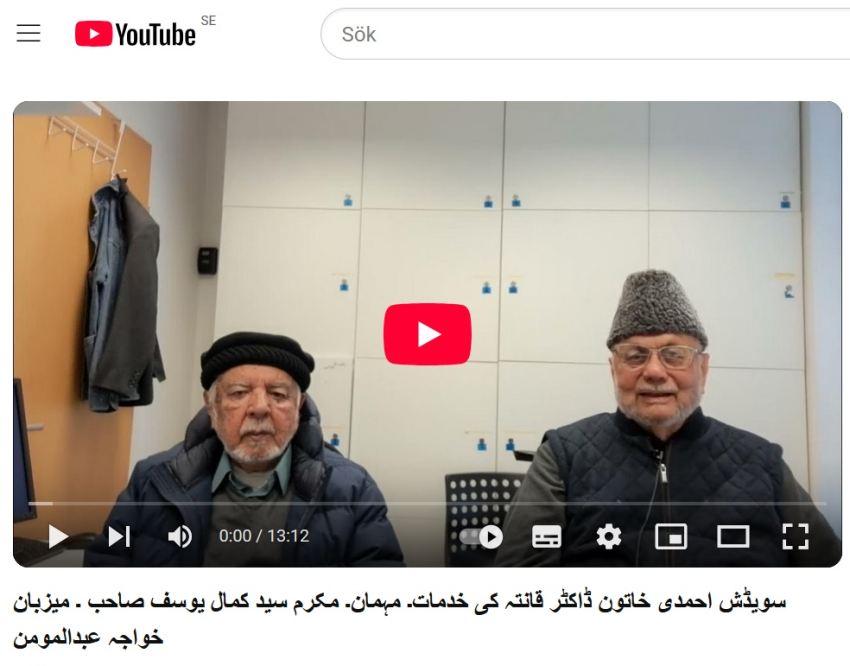
In 2024 Khawaja Abdul Momin Sb. interviews Kamal Yousuf sb., Norway, about Dr. Qanita. Episode 2
In 2024 Khawaja Abdul Momin Sb. interviews Kamal Yousuf sb., Norway,
about Dr. Qanita. Episode 2
 Kamal Yousuf sb speaking:
There are so many services that Dr. Qanita has rendered for the Jama’at. I will mention one of them. In Scandinavia, Denmark was the only country where we had a translation of the Holy Qur’an in its language. Norwegian and Swedish did not have translations of the Holy Qur’an at that time.
There were several translations available in Swedish, (most notably was the one by Zettersten, I think, I will try to check it), a Palestinian ambassador. His translation was widely accepted compared to others. Whenever we asked our Swedish Ahmadi, Saiful Islam Mahmud Ericson, to undertake a new translation, he used to say, “This translation is good; it’s just old. The Swedish language has evolved a lot since then. We can revise this translation to make it more modern.”
However, he actually started his own translation, but it was not finalized.
Allah granted this great opportunity to Hadhrat Khalifatul Masih III, may Allah be well pleased with him. At that time, Hudhur, the third Khalif, instructed Dr. Qanita to translate the Holy Qur’an into Swedish. She humbly responded, “I am not capable of doing it.” However, Hudhur assured her, “You will do it.”
By the grace of Allah, she began the translation work. She used Malik Ghulam Farid Sahib’s English translation as a reference to translate it into Swedish. Malik Ghulam Farid Sahib, a companion of the Promised Messiah, may Allah be pleased with him, was known for his excellent English.
Through Allah’s blessings, Dr. Qanita successfully completed the Swedish translation of the Holy Qur’an. It was all completed in Germany, while she stayed in Frankfurt am Main. But at that time, the Jama’at did not have the funds to publish it. Across Scandinavia, including Denmark, Norway, and Sweden, there was no budget to publish books, let alone the Holy Qur’an.
When a similar situation arose in Denmark, where Abdul Salam Sahib had translated the Qur’an, Hadhrat Musleh Maood, the second Khalifa, may Allah be well pleased with him, advised that it should be published in parts rather than as a complete volume, thus it was printed in three parts. The income from the sale of one part could then be used to publish the next.
Following this method, eight parts of the Qur’an were published in Swedish. Despite the lack of resources and experience, a man offered his help. He said, “Give me the manuscript, and I will publish it through my company without any monetary assistance.” True to his word, he published the translation at no cost to the Jama’at and went on to produce six editions.
We hired a company to publish the translation, and the owner agreed to do it. He took the manuscript from us and sent it for review to a Turkish scholar. However, when the Turkish scholar discovered that the translation had been done by a Qadiani (Ahmadi), he declared, “No one will even touch this translation.” As a result, the manuscript was returned to us with the explanation that it would create problems if published.
Thus, the Swedish translation remained unpublished for about seven-eight years. When the era of Hadhrat Khalifatul Masih IV, may Allah be well pleased with him, began, the situation changed. During the 100-year celebration of the Jama’at, there was a focus on showcasing how many languages the Holy Qur’an had been translated into. This Swedish translation was presented to Hudhur at that time.
During that period, the Jama’at still did not have substantial funds. However, by the grace of Allah, the Jama’at had progressed significantly. Previously, individual chapters of the Jama’at or certain members would take responsibility for publishing the Holy Qur’an. If I remember correctly, the Jama’at of Sharjah took on the responsibility for covering the expenses of the publication of this translation.
Finally, this Swedish translation was printed in 1988 and published as part of the 100-year Jubilee celebrations. It was a moment of great satisfaction to see Hudhur’s instructions fulfilled and the translation brought to completion.
This was one side of the story of the translation process.
Hadhrat Khalifatul Masih IV, may Allah be well pleased with him, began reviewing the English translation of the Holy Qur’an, translated by Hadhrat Maulvi Sher Ali Sahib, may Allah be well pleased with him, After completing the review, Hudhur instructed that in the future, if anyone want to translate the Holy Qur’an from an English version, it must be done using Maulvi Sher Ali Sahib’s translation.
Secondly, Hudhur stated that if anyone wants to translate from Urdu, they should use either his own Urdu translation, which had recently been completed and published, or the Tafseer-e-Sagheer by Hadhrat Khalifatul Masih II, may Allah be well pleased with him.
This created a new challenge, as the Swedish translation had originally been done while using the English translation by Malik Ghulam Farid Sahib, may Allah be well pleased with him. Therefore, on the request of Hudhur Dr. Qanita had to start the translation process again, this time using the English translation by Maulvi Sher Ali Sahib, may Allah be well pleased with him. By the grace of Almighty Allah, she completed this new translation as well.
However, there was another issue to address. Hudhur’s Urdu translation included a summary of each Surah, presented before the Surah itself. Hudhur instructed that in future translations, these summaries must also be included.
Following this guidance, the second Swedish translation was updated to incorporate these summaries before each Surah, ensuring it aligned with Hudhur’s instructions.
The English translation of these summaries was done by Kashif Rafiq Sahib from Urdu. He is currently serving as a missionary in Malmö, Sweden. Previously, he was stationed in Stockholm. After he completed the English translation, Dr. Qanita reviewed it and incorporated it into her own Swedish translation, completing the process for the second time. By the grace of Almighty Allah, she was blessed with the opportunity to finalize and complete this significant work, which was then published.
Regarding the publication of Qur’anic translations, Hadhrat Khalifatul Masih V, may Allah give him His support and His mighty help, provided guidance that in the future, any translation of the Holy Qur’an must use the Arabic script known as Khatt-e-Manzoor. This script was named after Manzoor Sahib, a companion of the Promised Messiah, may Allah be well pleased with him, who had previously published Yassarnal Qur’an. While teaching the children of the Promised Messiah, may Allah be well pleased with him, he had written the entire Qur’an in a distinct style, which later came to be known as Khatt-e-Manzoor.
So, these are the guidelines: If the translation of the Holy Quran is done in English, it should be based on the reviewed translation of Maulvi Sher Ali sb. If translating into Urdu, it should be according to the Tafseer Sagheer or the Urdu translation by Khalifatul Masih IV, and the Arabic script should follow the Khatt-e-Manzoor. May Allah reward Dr. Qanita for showing great courage and for beginning this task at a young age, dedicating all her capabilities and strength to these two editions.
Khawaja Abdul Momin sb: Has the translation been completed and published now?
Kamal Yousuf sb: Yes, both editions have been published. The second edition was published in 2018.
Khawaja Abdul Momin: Did you also work with her?
Kamal Yousuf sb: Actually, in the beginning I worked with her on the first edition. For the second edition, Hudhur permitted her to form her own team. For that team she selected Mir Abdul Qadeer sb, who is a retired missionary in Sweden and has a good understanding of English and Swedish, along with me. In the final edition, I had the opportunity to contribute, and Mir Abdul Qadeer sb, who like myself made contributions by discussing difficult passages with Dr. Qanita. May Allah reward everyone.
Comments: The interview is performed in Urdu and the revised contents are given here above in English.
Dr. Qanita’s comments: I would like to add my thanks to Sadia Lone, Malmö, Sweden, who, among other things, helped translate some of the short commentary also added in the second Swedish translation of the Holy Qur’an.
Thanks to Aqila LaHaye, Canada, for translating the Urdu text to English. The text has then been revised by Dr. Qanita, Sweden.
Link to the original Urdu version of the interview:
Dr. Qanita