Young Ahmadis are Leading Development
– A Brain Care Campaign
Some years back I met a young Ahmadi lady and her family. At that time I did not know that we, were to become friends, but I was interested in her ideas and her education because she aimed to become a neurosurgeon and being a forensic psychiatrist I was and still am very interested in everything related to the brain and mental issues. Now, a few years later, she has become my friend and I follow her development and plans with great interest.
Through her and others, I have learned that the young generation can be so enthusiastic and has so many amazing projects underway, that it is thrilling to see how this is opening the eyes of the world – not only to the programs as such, but to Ahmadiyyat as a platform for development and science.
It is with joy and pride that I present such a project and its mission here, founded by Judi Alkurdi, initiator and president of the Brain Care Campaign. Of the executive team, the members are just in their 20s, four are Ahmadi girls.
 The first article about this Brain Care Campaign was published here: https://themedium.ca/the-brain-care-campaign-a-student-led-initiative-founded-with-care-and-compassion/
Dr. Qanita, PhD in Forensic Psycchiatry, MD.
Name of Thesis: Risk and Prediction of Violent Crime.
Here follows the introduction to the purpose of the campaign:
The Brain Care Campaign is a women-led initiative dedicated to making mental and brain health education accessible to under-served communities.
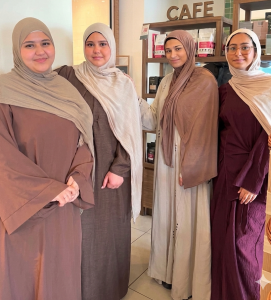 Our team is composed of 17 passionate women, including five executive members—our founder, president, outreach manager, social media manager, and social media assistant manager — who work collaboratively to translate neuroscience into meaningful, real-world impact.
 Founded by Judi Alkurdi, an undergraduate neuroscience student at McMaster University, the campaign was created from a powerful realization: while universities provide in-depth knowledge about the brain — its functions, chemistry, and the mechanisms behind emotions such as stress, happiness, and resilience — this knowledge often remains confined to academic spaces.
For many communities, especially those without consistent access to digital resources, this information is not easily accessible.
Judi created the Brain Care Campaign to bridge that gap. Her interest in neuroscience began with a curiosity about how much remains unknown about the brain. Recognizing the vast potential for discovery and innovation in the field, she was drawn not only to understanding the brain but to using that knowledge to make a meaningful difference.
With aspirations of becoming a neurosurgeon, her goal has always been rooted in service: to help others through something she is deeply passionate about and committed to excelling in.
Through her experiences volunteering in hospitals and working with nonprofit organizations, Judi noticed a disconnect.
While she was constantly learning, she rarely had the opportunity to apply her academic knowledge in ways that directly benefited the communities she served.
The Brain Care Campaign was created to change that — to transform education into action.
The campaign’s mission is to provide accessible mental and brain health education to under-served populations, including individuals experiencing homelessness, those in shelters, the elderly in nursing homes, and others who may not have reliable access to such information. In a world where many can easily search for answers online, the campaign recognizes that this access is a privilege — not a guarantee.
Through initiatives such as interactive workshops and digital outreach, the Brain Care Campaign aims to close this gap. Its first official workshop, taking place in April at the Good Shepherd Women’s Shelter in Hamilton, Ontario, represents a meaningful step toward community-based impact.
In addition to in-person efforts, the campaign fosters open conversations about mental health through its ongoing series, “What Does Mental Health Look Like to You?” — where volunteers share personal reflections through art, writing, photography, and storytelling. This initiative helps re-frame mental health as something that is approachable, relatable, and safe to discuss.
As the campaign continues to grow, it has also begun collaborating with media platforms and university networks to expand its reach and amplify its mission.
At its core, the Brain Care Campaign is about care — care grounded in knowledge, compassion, and the belief that everyone deserves access to understanding their own mind.
It is certainly a useful campaign and I am glad know that there are Ahmadi members of this compaign also. Thanks a lot for sharing the article to me. May Allah bless and guide the team.
Agree
This is a very good initiative. As the saying goes, a sound mind lives in a healthy body. Education on mental health is critical in our current age, and this can go a long way to help those who deserve it the most. May God bless your efforts with success. Amen.
Thank you so much for your comment, I fully agree with you!
This article truly means more to me than I can put into words. To have someone I respect and admire as deeply as you take the time to write about the Brain Care campaign—and about me—is something I will always carry with me.
Your support, your belief, and your kindness remind me why I started this in the first place. It’s incredibly special to be seen and encouraged by someone who inspires me so much. Thank you for not only sharing our work, but for uplifting it with such sincerity and heart. 🤍
Thank you for your kind words. For me it was a pleasure and no effort, and I really believe this project of uyours is very important.
May Allah bless their efforts and guide them, ameen
Yes, agree.
What an inspiring initiative! It’s wonderful to see young Ahmadi women using their knowledge and passion to serve others and make a real difference in society. May Allah Ta’ala bless Judi and her team and grant them great success in this noble work. Ameen!